What it does
The size of the whole
219 tracked files and 165 commits, from the design to the finished README and design thesis in two weeks. Application code: 9,456 lines in 67 files of strict TypeScript (no any anywhere), on Node 22, the 35-line brief re-render script (scripts/rerender-brief-html.mts) among them. Tests: 7,745 lines in 72 files, 474 test cases; with the fixtures of real page text the test code comes to 7,869 lines in 78 files. Database: 12 tables built up by 10 numbered database changes. Documents: 22,669 lines in 20 Markdown files (119,300 words), of which the twelve phase plans and design-decision records are the largest; counted with the plans and specifications, the 348-line README.md and the 205-line docs/THESIS.md included, they come to 24,377 lines. Counted with the documents kept beside the tracked files in the same project folder (the first-client protocol plan of 1,782 lines and its 448-line design, the 141-line build-to-claim plan, the 348-line working README.md and RUNS.md), the design record runs to 24,552 lines in 22 files and 121,578 words. The interface laboratory (.superpowers/brainstorm/) holds 4 design sessions, 17 HTML prototypes of 4,430 lines and 20 screenshots. Counted with those documents and the laboratory, the project holds 51,774 authored lines. Together with BidLedger the two projects hold 88,378 authored lines counted this way, and the two repositories 82,065 authored lines in 443 tracked files and 330 commits, and the record names 29 distinct systems across them.
By part, the application code is: synthesis (the reports, the takeoff engine, the brief) 4,554 lines; the probe library 1,144; the scanner 983; the orchestrator 919; the shared core (database, audit, dispatch, streams, text matching, schemas) 670; ingestion 341; the verifier 168; the command 42.
The command (bin/analyze.ts, src/orchestrate/run-bid.ts). One instruction, pnpm analyze <bid-directory>, turns a folder of bid PDFs into a governed run. It computes the bid's identity from its contents, opens or resumes the bid's own database, checks the audit chain, runs a canary call, runs the stages, closes the bid's database on every way out, an error included (a finally block), and leaves with an exit code that tells a script exactly what happened: 0 for success, 2 for bad usage, 3 for a missing folder, 4 for a runtime error, a rate-limit window that has not reopened among them. Switches turn on the material takeoff (CBA_GENERATE_MTO), the brief (CBA_GENERATE_BRIEF), a dry run with no paid model calls (CBA_DRY_RUN), the firm name printed on the outputs (CBA_FIRM_NAME), the run budgets and the retry delay.
What a run produces.
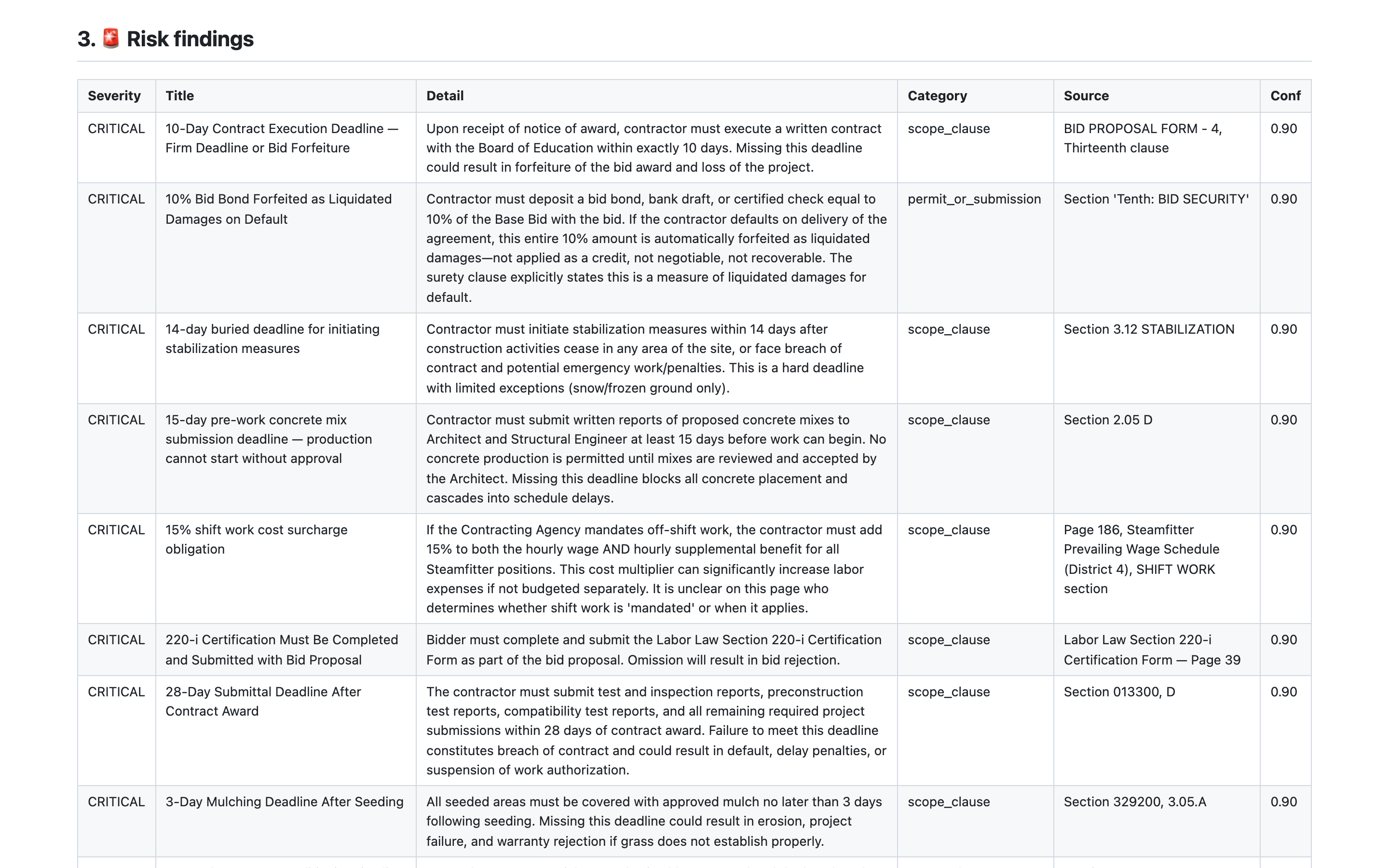
analysis.md, a ten-section cited report, ending in a section on coverage gaps (pages the run could not read) and a run reliability summary.analysis.json, the same findings as typed data, under a versioned schema.analysis.xlsx, the Material Takeoff workbook.analysis-brief.html,.mdand.json, the Bid Brief..cba/state.sqlite, the bid's full state, and two append-only evidence files:findings.jsonlandfindings-rejected.jsonl, the forensic trail of every claim the verifier threw out and why.- Page images of every drawing sheet at 150 DPI, and a debugging dump for every failed scan attempt.
scripts/package-handoff.sh(62 lines) then builds the folder a bidder receives:Bid-Brief.htmlandMaterials.xlsxat the top, with everything else under_reference/.
The six-stage bid-processing pipeline (src/orchestrate/pipeline.ts, stages.ts). The AI is used at one edge of the system and deterministic code (code that gives the same answer every time) surrounds it on both sides. The design calls this deterministic at both ends.
- S0 Ingest (
src/ingest/, 341 lines). Each PDF is hashed with SHA-256 so the same file is never processed twice and its identity survives a rename (doc_plus twelve characters of the hash). Each document is classified as drawings, specification, addendum, bid form or unknown, first from its text and then from its name. Text is pulled out with positions kept (text_items), cleaned of null and control characters that would otherwise break the hand-off to the model process, and every page records where its text came from (database change 009,text_source), so a renderer can tell a page whose text came out of the PDF from one that was empty or image only. Every text item keeps its position on the page (x, y, width and height), so a later stage can tell a title block from a general note. Encrypted PDFs stop with their own error (EncryptedPdfError). Drawing pages, and only drawing pages, are rendered to images at 150 DPI (about 3,600 by 5,400 pixels a sheet), and the scan stage downsamples each one once, to at most 1,200 by 1,800 pixels with its proportions kept, before the model sees it. The classifier reads the text first and falls back to the file name, and keeps unknown as a real kind rather than forcing a guess. - S1 Probe (
src/probe/, 1,144 lines, ten probe modules). Pattern-based readers that need no AI: addendum modifications, bid-form fields, bid metadata, building-code references (the New York codes, NFPA, UL, ASTM, the energy code, OSHA and federal CFR clauses, Industrial Code Rules, API standards, the county sanitary code and NSF drinking-water certifications, with overlapping matches merged so an OSHA clause or a multi-section energy-code citation counts once, each such case held by its own regression test), CSI specification sections, deadlines (notification windows, clearance distances and T-minus dates), a general prescan, drawing status from each sheet's title block (ranked on a ladder: a re-bid, revised or reissued set is high, because the bidder must know what changed; issued for bid is medium; a set marked for construction is low, flagged so the bidder can confirm the right set is being bid), and part numbers. The addendum probe reads each addendum's number, any bid-date extension, and every specification section and drawing sheet it modifies. Then the cross-document consistency check (cross-doc-consistency.ts, 169 lines) looks across the whole package for contradictions that can kill a bid, in three classes: an addendum that modifies a specification section missing from the base project manual, an addendum that modifies a drawing sheet no drawing set contains, and an addendum that moves the bid date the bid form still states. Every such finding is high severity and is cited to the addendum that introduced the conflict. Probe findings are re-checked against the page text and carry the top confidence, 1.0. - S2 Scan (
src/scan/, 983 lines). One AI call per page, on Claude Haiku 4.5, with a prompt written for that kind of document: drawings are read from their images, specifications and addenda from their text, and bid forms and unknown documents are passed over without a model call. Each finding falls in one of four categories: scope clause, question the owner must answer (an RFI), detail a vendor needs, or other. Pages run through a bounded pool, retries follow the class of failure, the rate-limit window is saved, and cost and time budgets stop the stage cleanly. The pool runs two pages at a time (src/scan/pool.ts, adapted from the bounded runner in his property-suite work), the width that keeps the provider's authentication stable under parallel calls. The page text is fenced inside delimiters in the prompt, so wording in a bid can never pass itself off as an instruction to the model, and every prompt is held by snapshot tests, so any change to one shows in review. The page time limit is 360 seconds, sized for dense demolition sheets with hundreds of callouts, and the call is hardened three ways: the prompt forces the output shape, the number of turns is capped at four, and a retry catches what slips through. - S3 Verify (
src/verify/, 168 lines). The hallucination firewall, described below. - S4 Reconcile, a registered stage held for an adversarial second pass and de-duplication. It records its events in the audit chain, so the slot is part of the run's history from the start.
- S5 Synthesize (
src/synthesize/, 4,554 lines). Verifies the audit chain again and refuses to publish if it has been altered, then renders the report, the data file, the takeoff workbook and the brief.
The verbatim-substring firewall (the hallucination firewall) (verify-citation.ts, 71 lines; verify-stage.ts; src/lib/text-match.ts). Every claim the AI makes must quote its evidence, and the quote must appear on the cited page word for word, or word for word once spacing is evened out. The CSI section or sheet number it cites must also appear on that page. A claim that fails is deleted from the findings table and copied to the rejected file with the reason. It is not marked down, flagged for review or retried. The design document explains the choice: a second AI grading the first is correlated noise, and a substring match is checkable, repeatable and free. In this trade the exact wording is what the estimator needs, to paste into an RFI or a vendor email.
The confidence ladder (database change 008). Every surviving finding carries one of three ranks: 1.0 for a probe finding, 0.9 for an AI finding matched word for word, 0.7 for one matched once spacing is evened out. A reader never sees anything weaker.
The content-addressed bid state model (src/lib/db.ts, 10 database changes, 12 tables). A bid's identity is the SHA-256 hash of its sorted file list and file hashes, so the same package is always the same bid and a changed package is a new one. Tables: bids (with blocked_until for rate limits and completed_at), documents, pages (status, text, image path, text source), text_items, findings (with a unique fingerprint per bid, so re-running never stores a finding twice), findings_rejected, pipeline_events, and the migration record, with four tables rebuilt in change 006 to add cascading deletes. The database runs in write-ahead mode, so a crash never leaves it half written. Every change after the first added a fact a real run showed was needed: the audit chain, fingerprints, document kinds, failure details, rate-limit windows, text provenance.
The hash-chained audit ledger (src/lib/audit.ts, 94 lines). Every stage start, finish, failure and synthesis action is appended to pipeline_events with a SHA-256 hash of the previous hash, its sequence number and its contents (sha256(prevHash|seq|payload), from a fixed starting value), inside one database transaction. A run checks the whole chain from the first event before it adds work, and again before it publishes; a broken chain stops publication with a chain_broken event. A test alters an event on purpose and confirms the break is caught.
The durable JSONL evidence streams (src/lib/stream.ts, carried over from his property-suite work). The findings and rejected-findings files are append-only and hash-chained line by line. Parallel page scans finish out of order, so writes are serialised by an exclusive sidecar lock file (opened with O_EXCL, so only one process can hold it), each line is appended with O_APPEND and synced to disk with datasync before the file closes, stale locks are cleared after a crash, every write is flushed to disk, and a resumed run picks up the chain from the last line.
The Claude process-dispatch boundary (src/lib/dispatch.ts, 380 lines, 24 tests; first ported from his habit-daemon project). The only place in the system that calls a model. It runs the claude command, and it never throws an error: every call returns a status of success, failed, timeout or dry run, so a failure can never be forgotten by the code that made the call. It sets the model, the output schema, the tools, the turn cap and a wall-clock limit that ends a stuck process. It sends images inline as content blocks rather than asking the model to open files, and it streams large prompts through standard input in the claude command's --input-format stream-json mode, which is how it got past the operating system's limit on command size (the E2BIG error) on large bids. A stuck process gets SIGTERM and then SIGKILL five seconds later, the pattern carried over from his property-suite scripts. The tool list (--allowedTools) is passed only when it holds at least one tool, because an empty value made the claude process abort; extra folders are opened to the model with --add-dir; the schema is stripped to the form the command accepts; and every structured reply is validated with Zod before any code reads it. The page scan grants the model its one file-reading tool only when the page has an image to view, so a text page can never open other files.
The preflight model canary (src/orchestrate/canary.ts). One cheap Haiku call before any work starts, so a dead key, an exhausted account or a broken model setting stops the run before it processes hundreds of pages. It has a 60-second limit and three turns, so a structured-output check in the operator's own Claude setup has room to work on the second turn; CBA_SKIP_CANARY skips it.
Retry, rate-limit and run-budget controls (src/scan/retry.ts, rate-limit.ts). Only temporary failures are retried (401, 403, 429, 500, 502, 503, 504, 529 and timeouts), up to three attempts with a 30-second wait between them (CBA_RETRY_BACKOFF_MS); the set was fixed from what real runs returned. A malformed prompt is never retried, because that wastes quota and hides the real bug. When the provider names a reset time, it is saved on the bid, and later runs refuse to call the model until the window opens, so an operator running it again never burns into a closed window. The two kill switches, CBA_MAX_S2_CALLS (2,000 pages by default) and CBA_MAX_WALL_MINUTES (90 minutes by default), treat a budget as a budget, and the first to trip wins: work in flight finishes, untouched pages stay pending, the run records cost_limit_reached once, the later stages still run on the completed pages so the bidder gets a partial report rather than nothing, and the next run resumes exactly there.
Resumable runs. Page status is written as work advances, so an interrupted run, whether stopped by a rate limit, a budget or a crash, rescans only the pages it had not finished. A run counts as complete only when it is marked complete and every output it was asked for exists on disk (expectedArtifactsPresent), so asking an old run for a newly added output re-enters synthesis.
The multimodal material-takeoff engine. A material takeoff (MTO) is the list of every material a job needs, with manufacturer, model and quantity, the sheet a contractor sends to vendors for prices. The engine (Phase 5) sends every drawing image to the model natively. An Opus 4.7 call drafts the takeoff (draft-mto.ts, 214 lines), grounded in an exemplar workbook from a hand-run analysis as a structural model; every line must carry a numeric quantity and the basis of the estimate. A second Opus call attacks the draft (critique-mto.ts, 200 lines) and returns typed patches, each with a confidence score, in five kinds: add an item, remove an item, change a quantity, change the canonical vendor, change the category. apply-patches.ts applies every patch at 0.7 confidence or above and sends the rest to the workbook's QA Findings sheet for a person to judge; if the critique fails or runs out of time, the draft goes ahead on its own. assemble-mto.ts deterministically adds the exclusions and groups lines into vendor packages under canonical vendor names. The takeoff schema forbids an empty quantity and requires a non-empty estimation_basis and a canonical vendor on every line, and a required applies_to_site flag marks items that belong to one site only rather than dropping them. Putting every drawing image in the first message makes the drawing impossible to skip, so the model cannot fall back on guesswork and invent part numbers when a page's text is partial. Opus runs the takeoff because a 20,000-token takeoff exceeds Sonnet's output cap; Opus finishes it in one pass.
The formula-driven Excel pricing workbook (render-xlsx.ts, 286 lines, built with ExcelJS). A Cover & Notes sheet, one sheet per site, a Consolidated sheet, Assumptions & Exclusions, and QA Findings. Each site sheet has eleven columns (item number, category, item, description, manufacturer, model or part number, quantity, unit, unit price, extended price, and reference or notes), and ends in a material subtotal, freight, sales tax and total. Totals are live formulas, so a contractor pastes in vendor prices and the workbook prices itself. The Consolidated sheet merges lines that share item, vendor, model and unit and keeps a quantity column for each site, so a vendor quoting both sites prices one list. Sheet names are cut to Excel's 31-character limit. Lines that must be checked on site are shaded yellow and marked VIF (verify in field).
The executive and interactive Bid Brief (generate-brief.ts, brief-prompts.ts, render-brief-html.ts at 1,548 lines). A single self-contained HTML file, styles and scripts inside it, so it survives being emailed, opens offline and prints cleanly. It sorts the bid into actions with search, filters, collapsible evidence under every item, checklists that remember what was ticked (saved in the browser's own storage, keyed by bid), RFIs ready to copy, status banners and print layout. It also renders as Markdown and as data. In detail:
- An Opus 4.7 call writes the brief under a strict schema, and every list is cut to its cap before the schema check (10 deal-killers, 15 each for money at risk, compliance, key dates and RFIs; in drawings-only mode 15 demolition items, 12 interface items, 12 walkthrough checks and 35 codes), so one oversized list can never cost the whole brief.
- Eight card types: deal-killer, money, compliance, RFI, demolition, interface, walkthrough and code.
- Search across every card with the
/key, filter chips (all, deal-killers, money, compliance, RFIs, open only), matches highlighted inside the cards, a sidebar that follows the reader's place, an expand-all switch, and a sticky progress bar showing how much of the bid checklist is done. - Ticks are saved in the browser under the bid's own key, so a reload keeps them while the envelope is assembled.
- A copy button on every RFI puts the question, why it matters and its source on the clipboard.
- A six-card facts snapshot (estimated budget, bid security, bonds, project window, minimum experience, irrevocable period) and a dates timeline split into critical dates, deadlines and milestones, both derived without a model call.
- Every item has a stable ID (DK-1, M-1, C-1, R-1), every value is escaped against injected script with snapshot tests to hold it, the layout works on a phone, and printing expands every card and marks finished items done.
The drawings-only estimator methodology (the drawings-only plan). A senior-estimator mode for when only drawings arrive: the brief and takeoff are built the way an experienced estimator reads a sheet set, and the takeoff carries every line to the sheet and callout it came from. On a set of seven image-only drawings with no text layer at all, it produced a 53-line takeoff from the images alone, every line cited to a sheet and callout and 16 lines marked VIF, with no change to the code.
Forensic Markdown and JSON report renderers (render-report.ts, 514 lines; render-json.ts). The report puts every finding beside its quote, page and confidence, and its last two sections show which pages could not be read and how the run behaved. Neither renderer calls a model, so a finished bid can be rendered again from its database at no cost; scripts/rerender-brief-html.mts does the same for the brief. scripts/convert-exemplar-xlsx.ts (271 lines) turned a hand-made workbook into the 1,525-line exemplar file the takeoff draft is grounded in.
What the output looks like. The flagship sample, which the BidLedger site publishes, is a public school district's oil-tank replacement bid of five documents and 653 pages: the scanner and probes proposed 3,315 claims, the firewall verified 2,806 and deleted 509, the brief shipped 87 findings as 47 actions in five groups (8 deal-killers, 15 money at risk, 12 compliance, 10 key dates, 12 RFIs), and the takeoff ran to five sheets. The full run, all five documents, ran overnight with nobody attending. Its first deal-killer is that the addendum, not the bid form, controls the bid date.
Artifact handoff, operational ledger and delivery gate. scripts/package-handoff.sh builds the bidder's folder; RUNS.md keeps the operating record of each analysis; scripts/gate.sh runs the type check and the whole test suite as one command, pnpm gate, before every commit.
The test system (72 files, 474 cases). Every stage, probe, renderer and contract has its own tests, with fixtures of real page text, an end-to-end test and a smoke test, and real model calls held behind CBA_RUN_REAL_LLM. The largest files test the brief's HTML (34 cases), dispatch (24), the scan prompts (19), the end-to-end run (18), the real-model acceptance suites (15), the report (14), the takeoff draft prompt (14), drawings-only mode (13), retry (12), code references (12), citation checking (10), the takeoff critique (10), rate limits (9), the page pool (9), drawing status (8), the classifier (8), the scanner (8), bid forms (7), the cross-document check (6), addendum modifications (6), the brief's status banner (6), the drawings-only banner (5), the drawings-only heuristics (4), the citation stage (4) and the deadline detector (4). docs/phase-3-manual-smoke.md (140 lines) sets out the hand check on real output. Tests run in separate processes (pool: "forks") because two native modules, the image renderer and the SQLite driver, crashed when torn down together in shared threads.
The design record. Twelve plans and decision records, one per phase, written before each phase was built, each with its own acceptance test; README.md (348 lines), written as a guide for the next agent; and docs/THESIS.md (205 lines), which states the system's claim, the problem, the philosophy, the reason for each major decision with the alternative it beat, what was tried and replaced, the trade-offs taken on purpose, and the five invariants a future change must not break.
The first-client protocol (design and plan, docs/superpowers/). A go-to-market engine designed to wrap the unchanged analyzer in four new modules (sourcing/, enrichment/, outreach/, tracker/): find open public bids and the estimators bidding them, verify their addresses, send each a personalised email built on an analysis of a bid they are chasing, and track every reply, with its buyer profile, pricing, cadence and decision rules in the companion spec. Beside it sit the design and plan for the marketing site (a 3,442-line plan and a 422-line design) and a 1,008-line briefing on discoverability by search engines and AI assistants, the start of BidLedger.
The interface prototyping and first-customer launch laboratory (.superpowers/brainstorm/, docs/visual-reference/). Four design sessions produced 17 HTML prototypes of 4,430 lines and 20 screenshots: hero variants built on the real deliverable's numbers, mobile states, the landing-page arc and the artifact layouts, worked out before the site was built.
The build-to-claim plan. The design for the analyzer's next generation, built on one principle: every claim the product makes is met by building the capability. Its spine is a single pipeline from drawings to dollars: measured quantities with their units and citations, multiplied by unit costs from a cited catalog seeded once and reused on every bid, so every dollar is computed and reproducible from two cited inputs; findings ranked in the brief by their dollar impact; vision reading for image-only specification and addendum pages; a takeoff critique that checks the specification against the drawings; and automated intake.
What it achieved
A single command reads a whole bid package and returns a cited report, a self-pricing material takeoff workbook and a one-file Bid Brief, every finding traceable to the words on its page and every rejected claim kept with its reason, and every step of the run on record in a chain that shows tampering. The bid documents also served Maxwell directly: he used them to read a bid tabulation and an addendum and to draft a formal bid protest over a competitor's failure to acknowledge a material addendum. The analyzer became the engine behind BidLedger, a bid-analysis service with its own website, intake and delivery system.
The problem it solves
A bid package is a legal instrument, and the expensive mistake is the clause nobody saw. Drawings for several trades, a project manual of hundreds of pages in CSI divisions, addenda that override the base documents, and a bid form that sets what is due when. One missed line (a temporary fuel supply during changeover, a ground-penetrating-radar survey near the work, a mandatory health-department notice before installation) can turn a fixed-price job into a loss larger than a small contractor's month. A small contractor has no estimating department; the default is to open each PDF and read.
Summaries are the wrong tool. A summary rewards leaving things out, and a bid rewards listing everything. A summary also invents citations that look exactly like real ones until someone pulls the spec at bid review. He named what the job needs instead: enumerative completeness with verifiable provenance, every clause listed, every one traceable to its page.
An invented finding is worse than a missed one, because it spends the reader's trust and points at a clause that does not exist. So the system is built on the opposite rule: nothing reaches the output unless its quote is on the page.
The AI should be untrusted by design (model-as-untrusted). Its output is a proposal; the verifier decides. That is why it sits at one edge with deterministic code around it, and why one AI is never asked to grade another.
A bid is durable state, not a prompt. Hundreds of pages, rate limits, crashes and new outputs added later all mean the work must be checkpointed, resumable and identified by its contents, with a record that shows if it has been altered, because the deliverable may be argued over after the bid is in.
The estimator, not the engineer, is the reader. The brief is one file that survives email and printing; the workbook prices itself from vendor quotes; every item carries its quote so it can be pasted into an RFI.
How he built it
He builds by directing AI agents. Here, that meant a written design, then one plan per phase, each plan built and tested before the next was written.
The design and twelve phase plans (docs/plans/). The design, then Phase 1, the skeleton, database, audit chain and dry-run path; Phase 2, ingestion and probes, with its own design-decision record; Phase 3, scan and verify, with a decision record; Phase 3.5, the takeoff; Phase 4, the takeoff "godmode" plan for multi-document fault tolerance; Phase 5, native multimodal images; Phase 6, multi-document ingest and fault tolerance; the brief; the drawings-only senior estimator mode, plan and design; and the README and thesis.
The five-clause acceptance gate. Phase 3 was accepted only when the scanner and verifier found five named clauses buried in a real bid package, clauses of the kind that cost contractors money, each with its quote on its page.
pnpm gate. Type check and full test suite in one command, run before every commit under his standing rules for agents.
THESIS.md as a governing document. Each major decision is written with the alternative it beat and the reason: a fixed pipeline over a free-roaming agent loop, because only a constrained edge makes citation checking a simple comparison; substring matching over confidence scores; a database over a JSON file; native images over file reads; Opus over Sonnet for the takeoff; a status-returning dispatch over thrown errors; retry by failure class over blanket retry; budgets that pause over budgets that abort. Its section on what was tried and replaced keeps every earlier approach on record, each with the mechanism above that now guards against it, so no later agent reintroduces it.
Build the thing only when there is a problem it would solve. His rule for what to leave out: no linter, no CI, no structured logger, no published package, the reconcile stage held as a registered slot, until a real problem calls for them.
Five load-bearing invariants, written for the next agent: the verifier stays a hard gate; dispatch never throws; findings stay fingerprinted; completion is paired with the outputs on disk; and every page event is in the audit chain.
Reuse from his own systems. The dispatch boundary came from habit-daemon and the evidence stream from the property suite; the exemplar workbook came from an analysis he ran by hand with a Claude chat, used to fix the shape of the takeoff.
Real packages as the test bed. Each phase was run on real public bid packages: drawing sets, project manuals, addenda and bid forms, including image-only drawings with no text layer.
Named concepts
The named concepts, defined
- Enumerative completeness with verifiable provenance: every clause listed, every one traceable.
- Deterministic at both ends (the deterministic-bookended LLM): the AI in one stage, fixed code before and after it.
- The verbatim-substring firewall, also the hallucination firewall.
- Model-as-untrusted.
- Append-only tamper-evident truth: the hash-chained ledger and evidence streams.
- Resumable staged pipeline.
- The confidence ladder: 1.0, 0.9, 0.7.
- Never-throws dispatch.
- Kill switches that pause rather than abort.
- MTO godmode, the Phase 4 takeoff plan.
- Senior estimator mode, the drawings-only methodology.
- VIF (verify in field) rows.
- Deal-killers, the first group of the Bid Brief.
- Build the thing only when there is a problem it would solve.
- The record's systems for this repository: Bid-analysis command surface; Six-stage bid-processing pipeline; Content-addressed bid state model; Hash-chained audit ledger; Durable JSONL evidence streams; Claude process-dispatch boundary; Preflight model canary; PDF text-and-image ingestion; Document classification and routing; Deterministic prescan; Construction-domain probe library; Cross-document consistency analysis; Kind-specific scanning prompt system; Bounded fault-tolerant page scanner; Retry, rate-limit, and run-budget controls; Citation verification and confidence ladder; Forensic Markdown and JSON report renderers; Multimodal material-takeoff engine; Formula-driven Excel pricing workbook; Executive and interactive bid-brief system; Drawings-only estimator methodology; Artifact handoff, operational ledger, and delivery gate; Interface prototyping and first-customer launch laboratory.
What it shows
Maxwell built a system that uses AI where it is strong, reading dense drawings and long specifications, and makes it answerable to the documents: every claim checked word for word, every decision recorded in a chain that shows tampering, every run resumable from the page it stopped on. He took a trade problem he knew from the inside, the clause that sinks a fixed-price bid, and turned it into a governed machine whose outputs an estimator can act on and defend.