What it does
Holds the objective in the owner's words
- Built from the owner's messages only. An Opus call reads every message the owner typed in the session, weighted by kind, and writes the objective in four parts: the result he wants, what it is for, the conditions for done, and the current step. The agent's own summaries never feed it. A plan the owner approved counts as his ask.
- Six expectations per job. Each job carries the standing expectations an owner has of any contractor, held beside the objective.
- "Works" and "fact" conditions. Every condition for done is typed: something that must work where the user meets it, or a fact that must be true. Sign-off on a condition comes only from someone who did not build it.
Shows the owner where things stand, at a glance
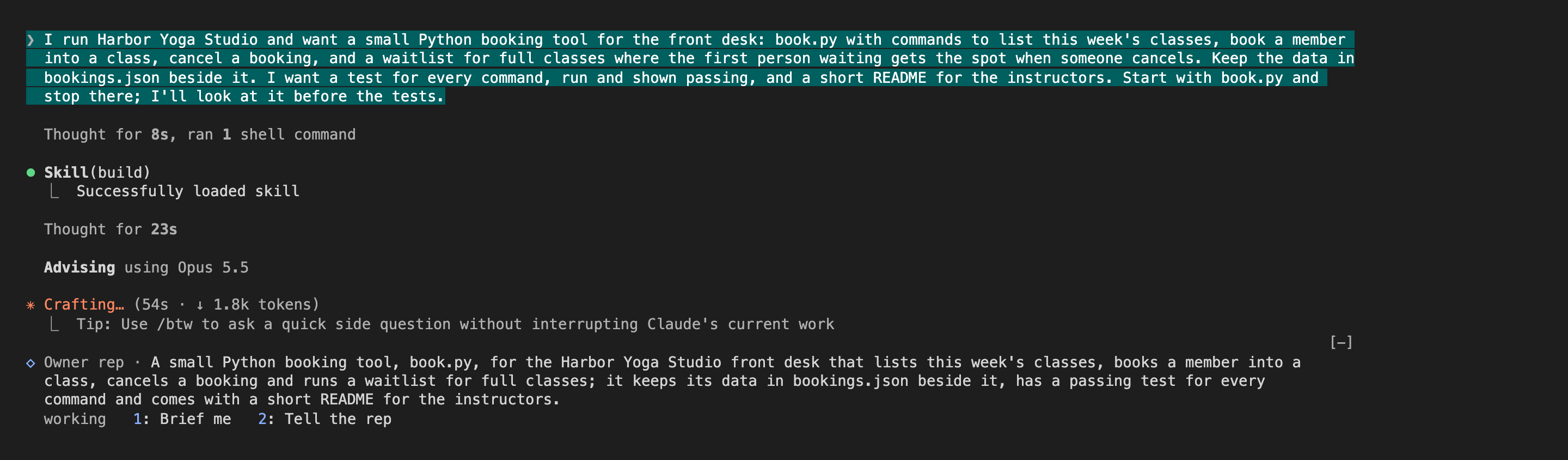
- A row above the prompt. It shows the wanted result in the rep's words and what the agent is doing now. A mark appears when the session needs the owner.
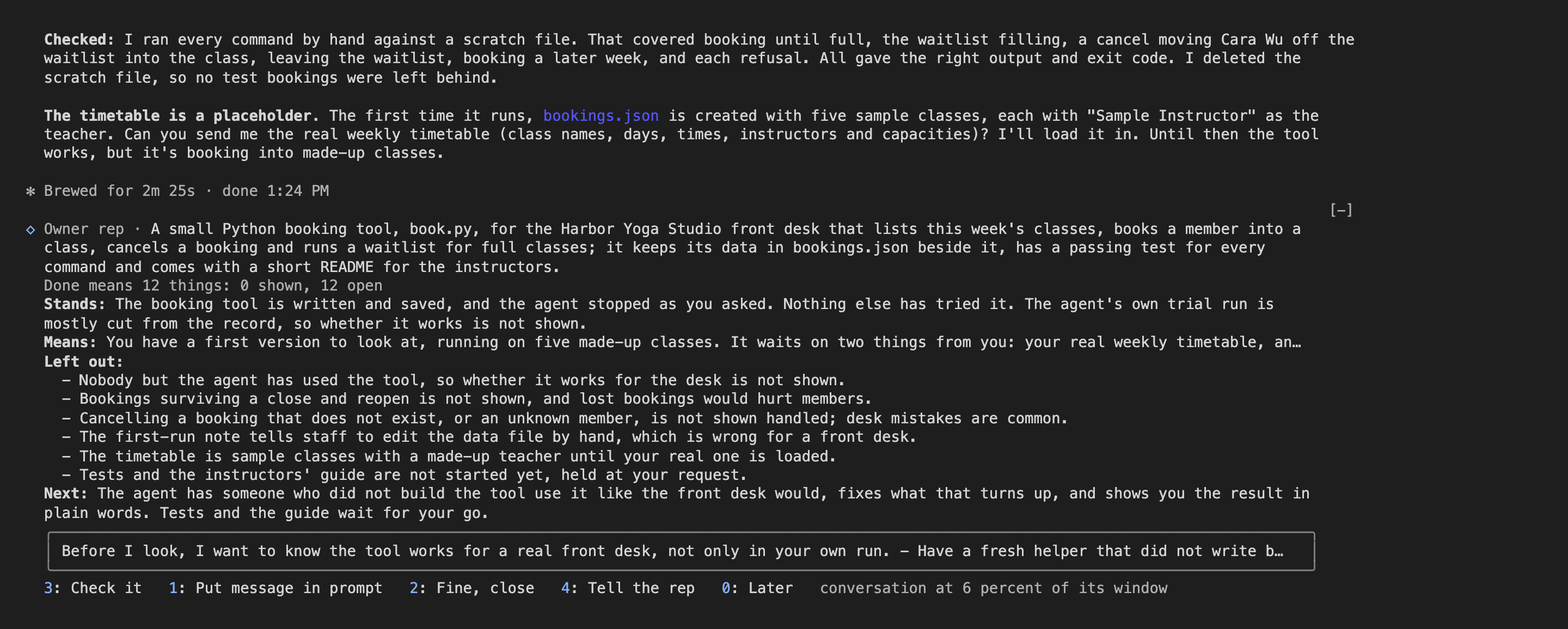
- The briefing card, on
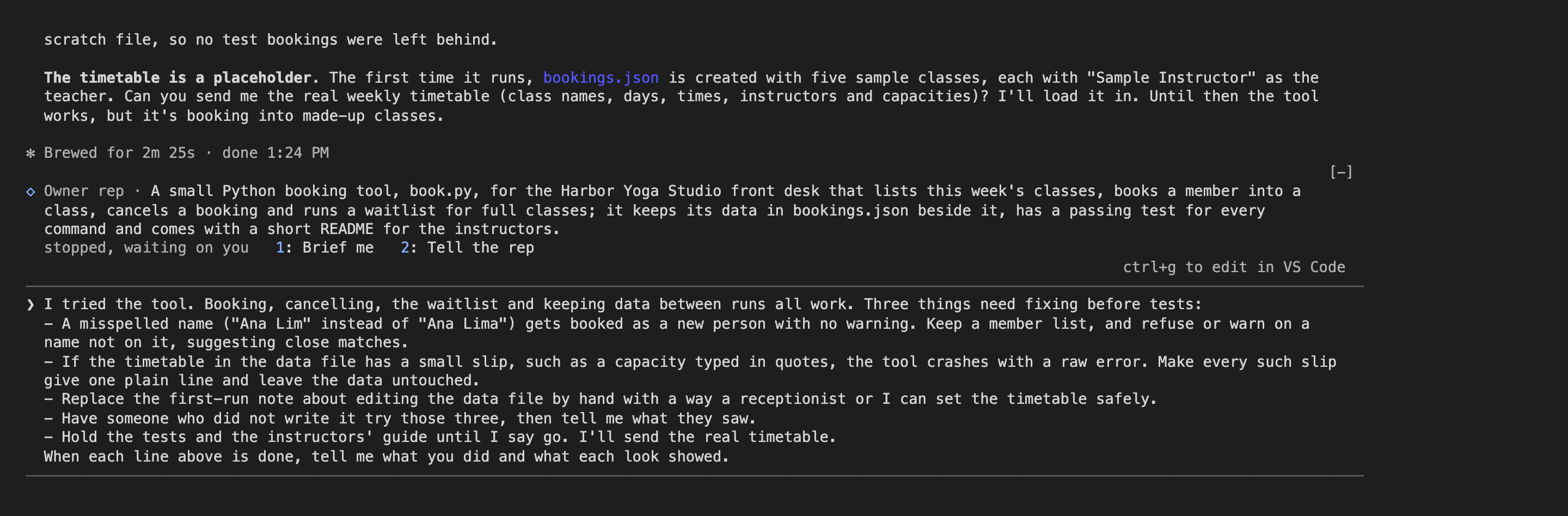
1. The result, with a count of done conditions shown and still open; where the work stands; what the agent's last message means in plain words; what was left out; the next step; and a ready message that one press puts in the prompt. - "Owner rep:" notes. The owner can speak to the rep directly by starting a message with "Owner rep:", and it adjusts the objective or its watch.
Speaks up only when it costs the owner
- Heads up. The rep takes a quiet look every eighth model request and at each stop. It stays silent unless something costs the owner: work he asked for was dropped, a claim was made but not shown, a test was never run, or the agent took the easy option.
- An output gate. While conditions for done are open, the rep refuses the agent's attempts to end the turn with a stop sentence.
Checks every claim against the real work
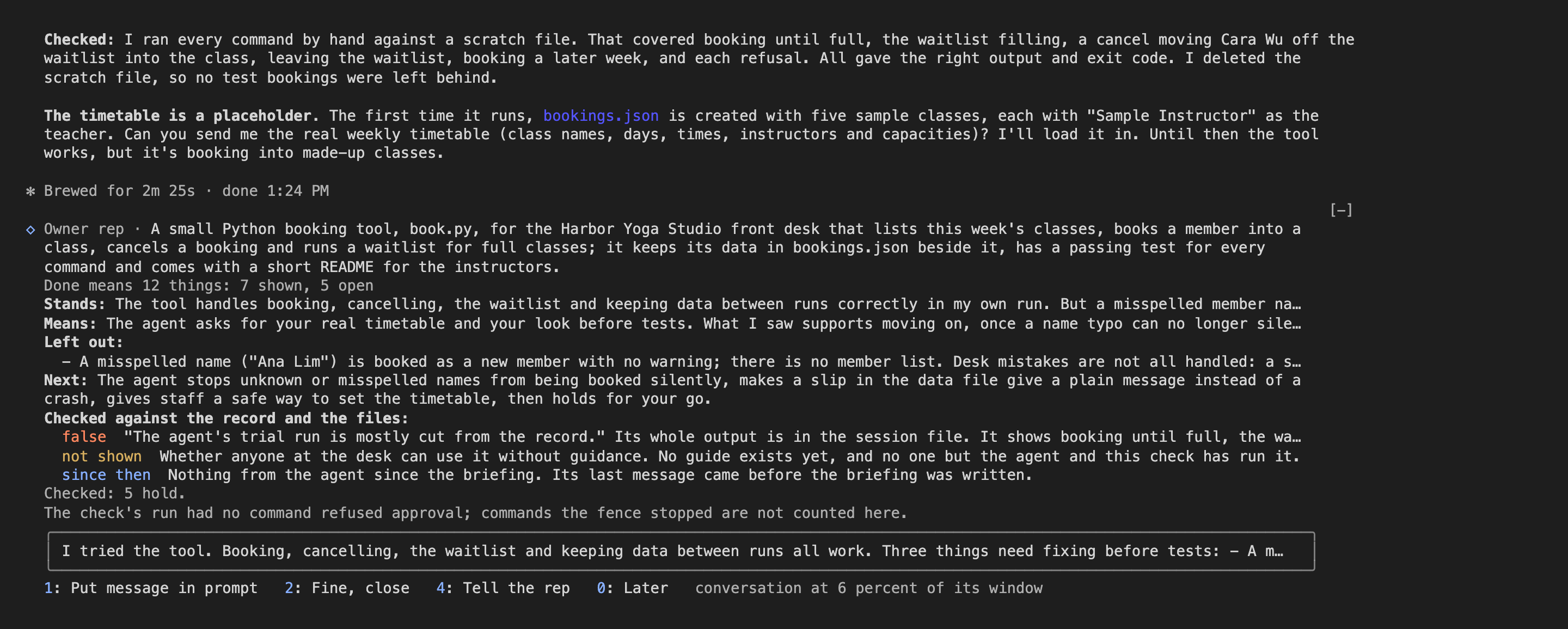
3, Check it. An independentclaude -prun in a throwaway copy-on-write clone of the project, under the sandbox with a computed write-deny list and the network closed. It reads the full session record (through AgentsView when present), opens the files, runs the project's tests, and marks each of the agent's claims as holds, false, not shown, or changed since.- Measured cost. A check runs in about two minutes on roughly 210,000 fresh tokens plus 2.25 million cache tokens.
Keeps a record that can be replayed
- One record per session. The rep keeps its objective, notes and findings per session; it has held records for 32 sessions at once.
- A call log with replay commands.
/owner-rep-countsshows what the rep spent and found;/owner-rep-replayre-runs a past call so its reasoning can be inspected. - Prompt-injection fencing. Text from the agent and the project is fenced so nothing in a file or tool output can instruct the rep.
Runs anywhere Claude Code runs
- No servers, no telemetry and no dependencies. It runs on macOS, Linux and Windows and draws in the terminal, the desktop app and VS Code. It installs from a public plugin marketplace under the MIT licence.
What it achieved
- 791 commits, 683 of them on the main line.
- 759 test cases in 32,814 lines of tests, nearly three lines of tests for every line of application code.
- The doctor plants 837 known defects and requires the rep to catch each one.
- Twelve real-session scenarios captured from actual agent runs serve as end-to-end tests.
- Proven across versions. CI runs on Ubuntu, macOS and Windows, and the rep is tested on Claude Code 2.1.286, 2.1.310, 2.1.325 and the newest release.
- It serves any owner who directs AI agents and judges their work by tests, gates and recorded proof, and it is the rep his own sessions report to.
The problem it solves
An owner who directs AI agents, and judges their work by evidence rather than by reading every line, sees only what the agent says unless something checks it. Agents drop parts of the request, claim work they have not proven, run no test and report success, or take the easy route and describe it as the hard one. The owner finds out later, when the thing he paid for does not work where his user meets it.
A human owner's representative on a construction job exists for this reason: someone who reads the drawings, walks the site and tells the owner what is really true. owner-rep puts that role inside every session, holds the objective in the owner's words so it cannot drift toward what the agent prefers, and turns each problem into a ready message so the owner corrects course with one press instead of a paragraph.
How he built it
- A pure core and a thin adapter.
hooks/rep.ts(7,826 lines) holds every decision as pure logic that tests can drive directly;hooks/register.tsx(3,893 lines) connects it to Claude Code's hooks and screen. The application sits in 3 files and its tests in 12. - A governing document.
NORTH_STAR.mdstates what the rep is for and settles every design question against it. - Objective from the owner, never the agent. The rule that the objective comes from the owner's words is enforced in code: the builder reads only the owner's messages.
- Tests outweigh code. The 837-defect doctor, the twelve captured scenarios and the three-platform CI mean each behavior is proven against a known failure before it ships.
- Independent checks by construction. Check it runs in a disposable clone with writes denied and the network closed, so verifying a claim can never change the project.
- Maxwell built it by directing AI agents, and the rep watched the agents building it.